India’s moment to shine globally has arrived. The only question is, how big?
Nov 10, 2024 - Anurag Singh

As the West today grapples with a demographic decline, India is at the cusp of once-in-a-lifetime demographic dividend opportunity. The country’s largest population cohort is entering their 30s and the spending binge has just started. Here’s why there is no stopping this economic engine now.
We all go through stages of a lifecycle. While some deal with life better than others, there is no question that in boarder lens, life stages are the same for everyone. You are nurtured as a child, expected to provide for family when grown up, and pass on the baton to the next generation.
On a life bell curve, we have the least responsibilities when younger. So are our earnings. The low earnings and lesser responsibilities come back at later stages as we begin to relieve ourselves from the demands of life. Regardless of wealth disparities, we know that we are likely to spend the most during the earning phase of life and live off the assets during the later period.
A nation is no different. Consider every country like an individual with its age as the average of all citizens combined. You will see the country displays most of the characteristics that apply to an individual over a lifetime. Now, I’m not suggesting that all countries are equal or that nations can’t beat this cycle by innovations and policy reforms. However, there comes a stage in life for every country when it grows regardless of the circumstances. There can be debates about potential versus actual, but the growth is nearly assured.
India is sitting right at that moment where next 20 years of growth in average income is beyond debate. The only question is: How big will it be? We’ll see why.
Spending peaks during prime earning age
The Consumer Expenditure Survey conducted by Bureau of Labor Statistics in US publishes information classified by characteristics such as income, household size, and age of the individual. The survey indicates that annual expenditures and pretax income are “hump” shaped over the lifecycle, lowest for the under 25 years group, then increasing to their highest levels for the 45-54 age group, followed by a steady decline. Have a close look at the graphic below. You see how the spending begins to increase at 35 and peaks at 55 years. Not surprisingly, the income shows a similar trend.
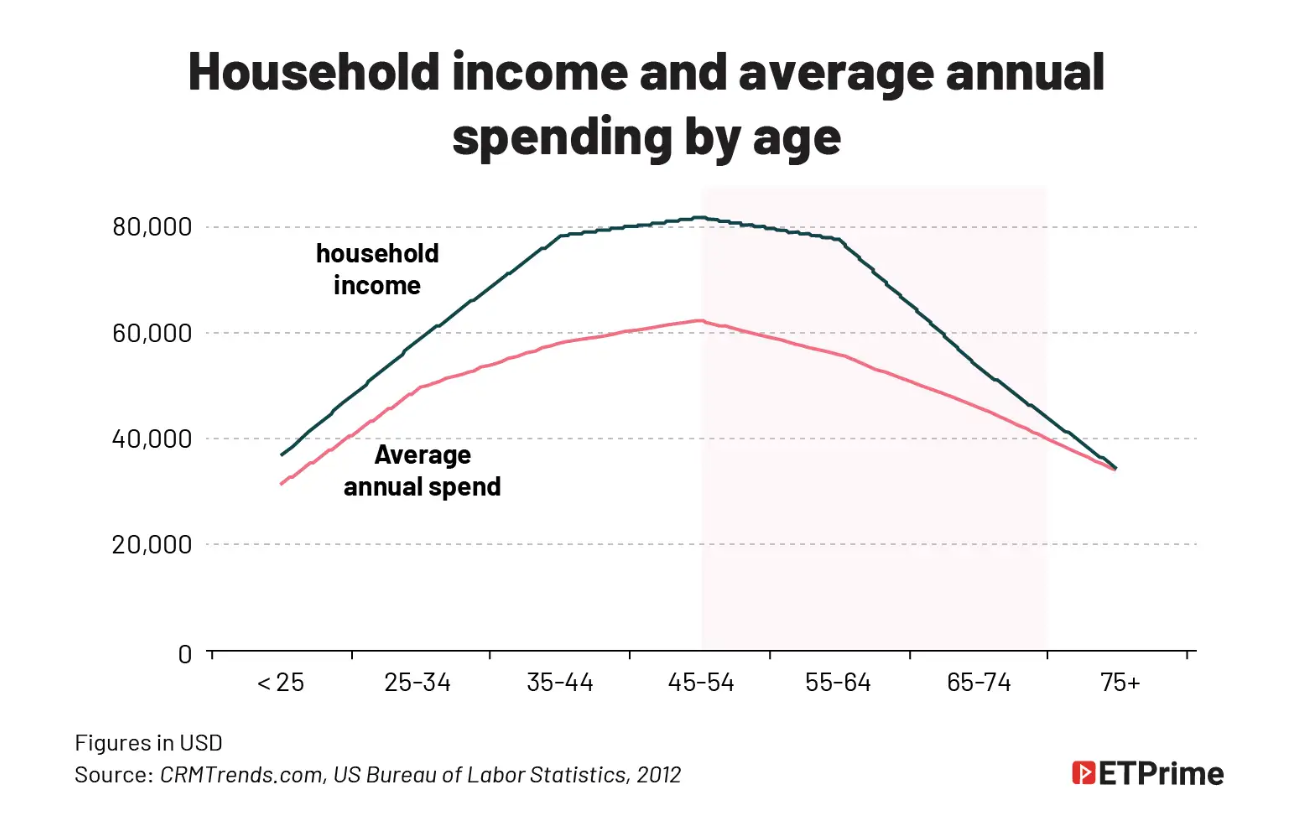
The experience is similar across the other developed nations as well. While the US spending peaks in the 45-54 age group, Japanese spending peaks at age 55 and UK’s at 50. After the age of 75, the US spending falls 46% from its peak and UK’s declines by 53%.
So why does the spending peak during the 35-55 age span? You can relate this perfectly to the life events that follow in sequence. As one acquires education in early years, the spending is less on lifestyle needs. The education itself may be funded by loans. As one enters the job market, the earnings initially are low and cater largely to immediate needs. The first critical landmark is marriage that creates a shared responsibility. Family needs and the arrival of children certainly make you look at responsibilities differently.
With time, improved skills and experience increase your income. However, that also accentuates the long-cherished lifestyle preferences that quickly capture the excess income. This is called lifestyle inflation. Buying first home, better car, more eating out, travel, and entertainment. There is a constant hustle of catching up to the latest and the greatest you can afford. This continues for a decade. As children grow up, they demand better education opportunities. Just like your holiday checklist, the kids want to go global. Welcome to the middle-age spending hump. This usually peaks around mid-fifties for most.
As this happens, your spending contributes to the national GDP. One person’s spending is other person’s income. Higher collective spending of citizens is more national income.
How is India placed for the opportunity?
It is no surprise that the western world has reaped the benefits of this lifecycle curve perfectly when it mattered. In 1950, the US for instance, had nearly 39% in the age group of 25-54 years and another 45% under 25 years. We saw how that story unfolded for the next 50 years. Today, however, a growth of 2% is considered rather ambitious in the US. The story is no different for European nations.
How does India look on this metric today? The best ever!
Examine the graphic below based on Indian government census in 2011. We can extrapolate the same forward. What do you see for 2036? India has the highest population segment in the 35-39 age bracket. This simply means the cohort will be between 45 and 50 years by 2046. Well within the peak spending age.
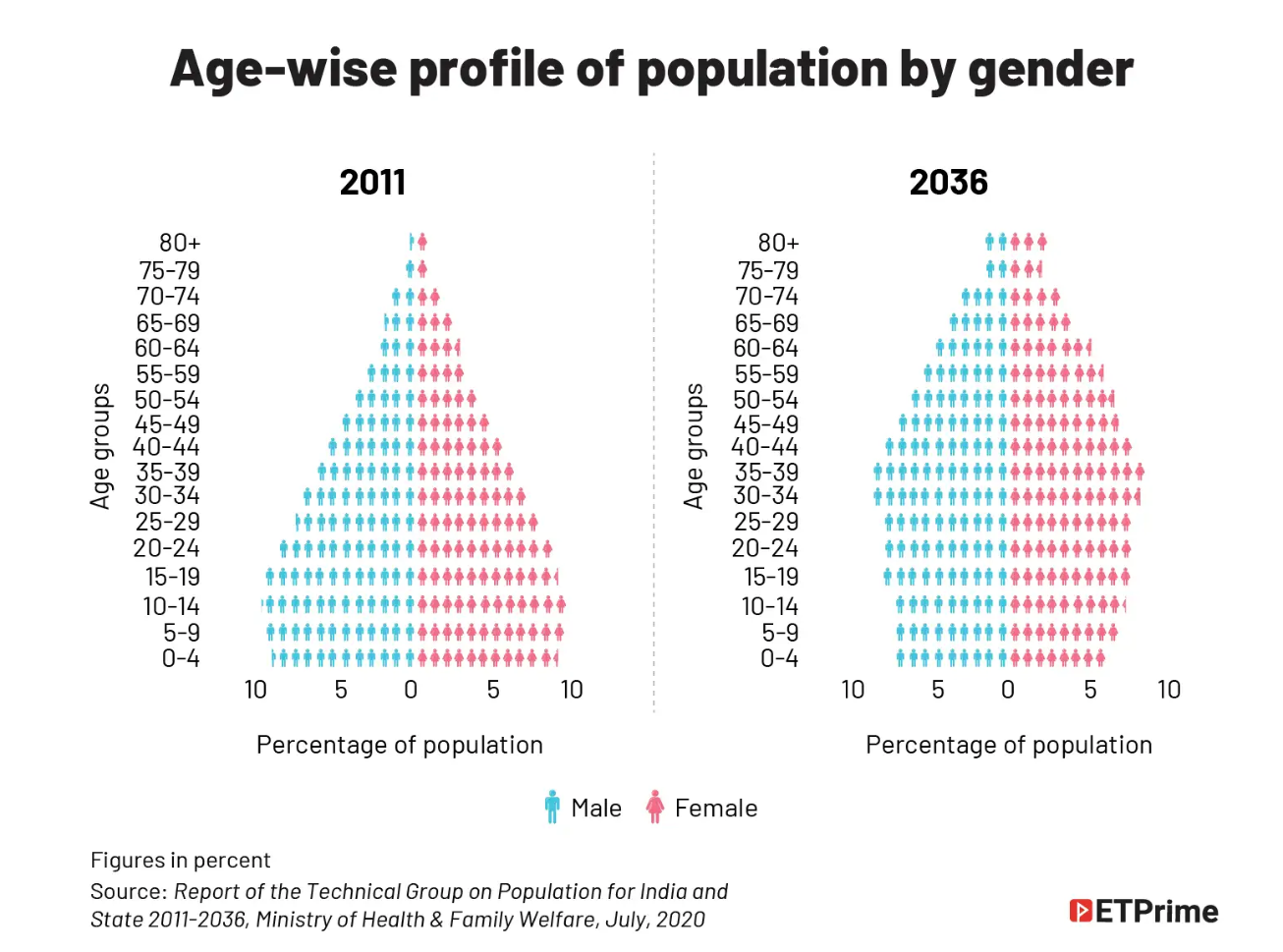
So, where do we stand in 2024? Of all major economies, India has the highest population proportion in the peak income and spending bracket. This demographic will continue to earn, grow, and spend for the next 20 years. It will create capacity constraints and further demand pull for goods and services. If you experience the airports, hotels, and urban landscape overly crowded, well this is the reason why. The ever-growing supply can still not catch up with the unsatiable consumer demand. This is the greatest opportunity phase for a nation to rise. The pace can be debated but there is no stopping this demographic engine.
The final cut
Youthful population creates spending surge as the experience from the western world indicates. As the West grapples with a demographic decline, India is at the cusp of the once-in-a-lifetime demographic dividend opportunity. Its largest population cohort is just entering their 30s. Their spending binge has just started and will continue for the next 20 years. They will demand more houses, cars, education, healthcare, restaurants, hotels, and airlines. That too at a scale never seen before.
This creates an opportunity for businesses to serve this spending wave. This will certainly show up in the profits of corporations, both listed and unlisted. And it will invite foreign money that may want to join the growth party. Given the right stimulus and government policy, this demographic movement can create wonders, as we have seen in the developed countries.
India historic demographic moment has arrived. There is no stopping this economic engine now. Fasten your seat belt and enjoy the ride.
The article first appeared for The Economic Times in Oct 2024.