India bull looks tired. How long will it take to reclaim new peaks?
Mar 30, 2025 - Anurag Singh

In the past 20 years, the Nifty 50 has returned 12% annually. Smart investors believe Indian markets can do far better than this in the coming decade. But markets are cyclical in nature. There is a high chance we may actually get lower annual returns compared to the past.
Over the past week, Indian equity markets are up almost 2% with the Nifty trending at 23,589. Retail investors are happy and renowned experts are going out and claiming it to be the ‘start of a new bull run’. However, there are a few who feel the next 10 years will be different from all the past boom periods that India has witnessed so far.
In the past two decades, the Nifty 50 has returned 12% annually. Smart investors believe the country can do far better than this number in the coming decade. But markets are cyclical in nature. There is a high chance that we might actually get lower annual returns compared to the past.
Markets have had a sizeable correction from the highs seen in last September peak. It has been a painful grind in the last six months for investors. For nearly 80% of them, the correction is somewhat a new phenomenon, and totally unexpected. These new investors had come in for linear returns and were trained to ‘buy the dips’. They had the best for the past 5 years, up until now.
When the story was about demographic dividend and companies rising to fulfill the unsatiable demand from young India, why should that come to a halt? Why do stocks correct after all when the going is so good? And why would foreign investors want to leave in such a hurry?
All great questions. For those who started after 2020, there are some valuable lessons to learn here. Well before they prepare for the next bull run.
What was driving the rise?
When you buy a stock, you buy a share in its earnings. The earnings per share (EPS) decides the price it should trade at (at least some of it). The other element comes from market sentiment, which relies on future prospects for the current earnings. What India witnessed last five years was the boost on both these elements. Let us look at earnings first.
Nifty EPS was around INR430 by end of 2019. During the next 4 years, by the end of 2023, it rose to INR950. That is an astounding CAGR of 22%. If you looked at the historical 10-year trend till 2019, the range was much below 10%. This earnings surprise increased valuations. Common sense would tell you that Nifty should double too. And it did. From 12,500 to neat 25,000 rise was largely justified. At least in theory!
If we broaden this story and look at the entire listed corporate space, corporate profits jumped from around INR4 lakh crore (USD45 billion) to INR16 lakh crore (USD170 billion) during the same duration. This was nearly 4.8% of GDP. No wonder, we saw a bump in valuations across Nifty 500 Index.
Markets assumed the similar rate of growth and priced the stocks accordingly. Not to forget, the flow of domestic money to mutual funds provided more gas to stocks outside of Nifty 50. The mid- and small-cap stock prices grew significantly higher, at almost 30% CAGR for 4 years. This was far in excess of the EPS growth in these stocks.
This super growth phenomenon however is always shortlived. We’ve had these phases before. There is nothing new about this.
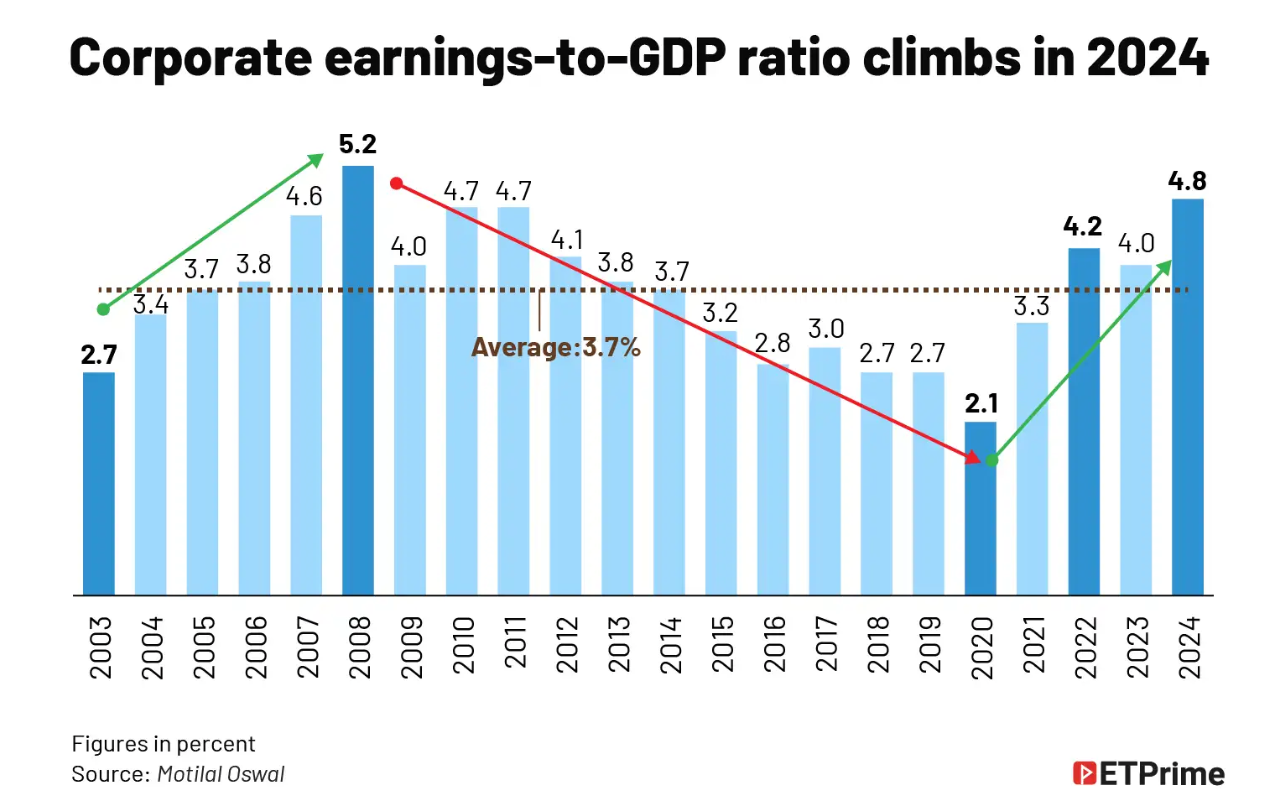
Look at the above chart for corporate earnings (India Inc market cap) to GDP ratio, which is a very reliable indicator of how well the listed market is doing within the larger economy. We see that corporate earnings grew from 2.1% of GDP to 4.8% of GDP between 2020 and 2024. However, we can also see a similar rise to peak between 2003 and 2008, after which a period of slowdown began till 2019. While this author doesn’t imply that the path will exactly be the same now, the key message is that earnings are cyclical. And so is the Indian economy.
Why did the markets fall and why now?
Though the market had accounted too much exuberance in 2024, it failed to recognise this EPS growth was never sustainable.
So, why did the earnings spike post 2020?
A confluence of factors resulted in earnings growth post 2020. Firstly, banks’ balance sheets were already clean after years of NPA write-offs post 2014. After pandemic, we had a sudden demand surge — IT services got huge demand boost from US, there was discretionary revenge spending by consumers & finally the govt capital expenditure increase 4 times to INR11 lakh crore (USD125 billion). All of this happened within 3 years. Indian retail credit penetration increased from 20% of GDP to 43% of GDP. So much of the consumer spending was done with credit binge too.
All that spending is behind us now. So, unless you have a reason to believe that the economy has drastically improved after 2020, it is safe to assume that the earnings growth will also correct. And this is already underway since 2024. Estimates for Nifty 500 companies are at 7% topline growth. This is just about keeping up with inflation.
For context, look at the topline growth for Nifty 500 companies below. It tells a similar story since 2010 when sales growth slowed after 2009. And then the huge spike after 2020.
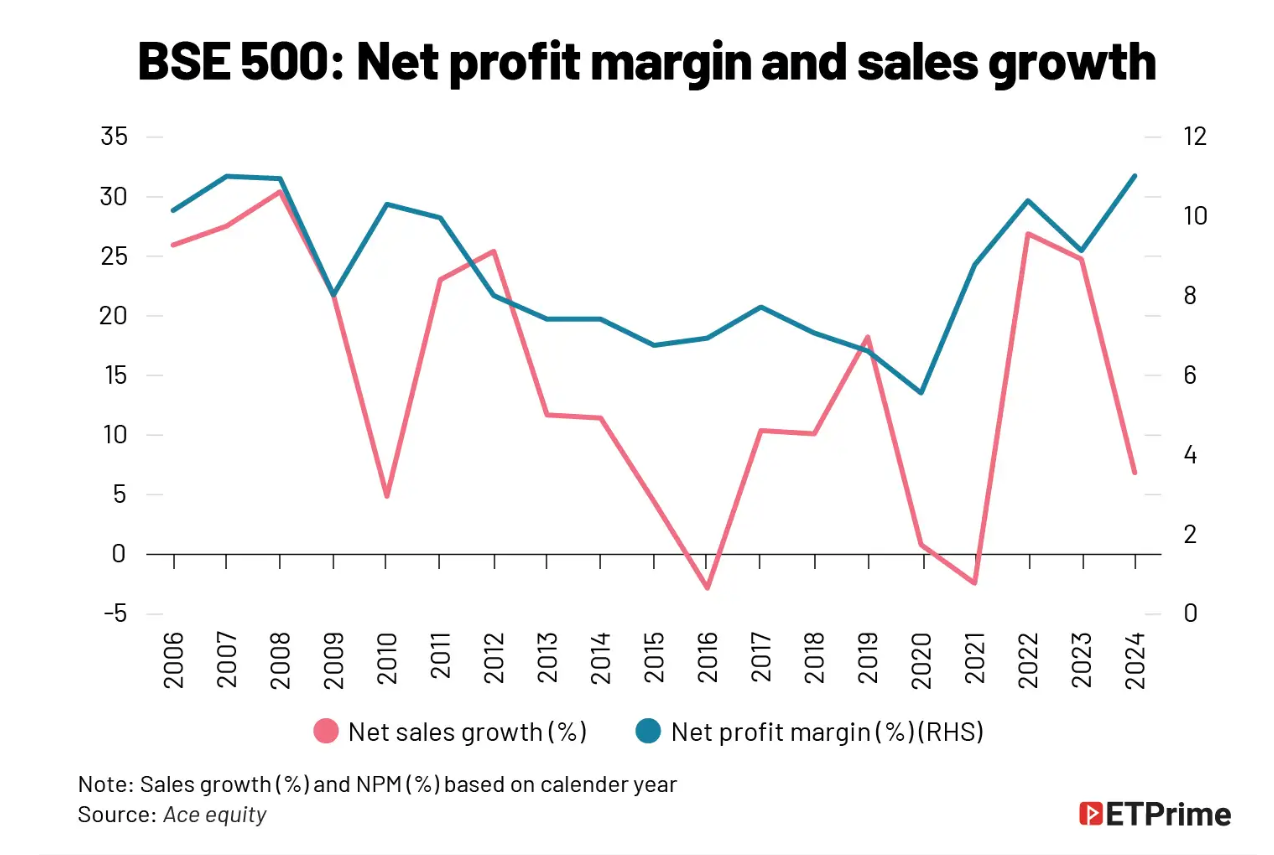
While sales growth slowed by 2021, margins expanded, which concealed the slowing topline. That provided some cushion to the EPS story for a year. However, EPS can’t grow continuously if topline stagnates.
When will markets capture previous peaks?
Depends on your outlook on earnings and India’s economic growth. It is worth noting that after 2009, corporate earnings grew in single digits for the next 10 years. Nifty 50 and Nifty 500 returns were in the range of 8% and 7%, respectively for the next decade.
The situation was not exactly the same then, and the reasons may be different now. But the economy does go through a period of moderation after every exuberant cycle. So do markets.
The current correction should not be seen as a minor blip that recovers fast. It is unlikely to be a V-shaped recovery because it is not driven by a special event. It is a sales slowdown which has been in the making for 18 months now. Just that the earnings took some time to reflect that.
Thus, the recovery may take as much time as it takes for the consumer to recover. Also remember, the market slowdown impacts gross spending levels too. If you don’t have stock buoyancy, you are unlikely to buy bigger homes or take that exotic holiday. As the government tries to contain fiscal deficit from 4.8% to 4.4% of GDP this fiscal year, the spending boost from the Centre may become difficult.
With history, it is safe to assume that junk stocks will not gain the glory they did. But eventually, markets do recover if the economy continues to march forward. That is the key here. If the GDP growth stays in the 6% range, corporations will figure out a way to come out of the earnings stagnation. And some new winners will emerge.
The author feels that next 5 years may be a period of moderate growth in India, wherein market absorbs the current high valuations. They may appear cheap on current earnings but are probably not accounting for likely slower growth in future.
Eventually, the returns from Nifty 500 are likely to be around 10% for the decade between 2021 and 2031. So, you will be fine as long as your portfolio is well balanced. Ignore the noise and get back to work. If you were expecting this to be a linear rise, then that assumption was never right to begin with.
One last thing
The comparisons that forever bullish gurus quote from US markets don’t apply to any other country. If you pick a historical point from US markets, you can prove almost anything. India story works differently too, unless the economy undergoes a drastic transformation, something like China had for last 30 years. While that is possible, it is also extremely rare.
And this is exactly where the bulls and the bears begin to differ substantially. You can take your pick. The perma-bulls continue the story of India imitating China growth. The story has been alive for 25 years now. Evidence and experience do not justify this thesis.
A healthy dose of realism is always good in investing. Else, you end up buying expensive con stories from faceless sellers who get rich with your money. Some of you may have realised that by now. The India bull ran fast as it could. But it needs some well-deserved rest. Let it be for now.
The article first appeared for The Economic Times in March 2025.